Have you ever wondered how some people manage to seemingly effortlessly balance career, family, and demanding further education, while others fail even at a simple daily list? The secret lies not in the number of hours available to us – everyone has 24 of them. The difference lies in the system. Time management for learners does not mean doing more things in less time, but rather doing the right things at the right time with full attention.
The Eisenhower Matrix: Separate Wheat from Chaff
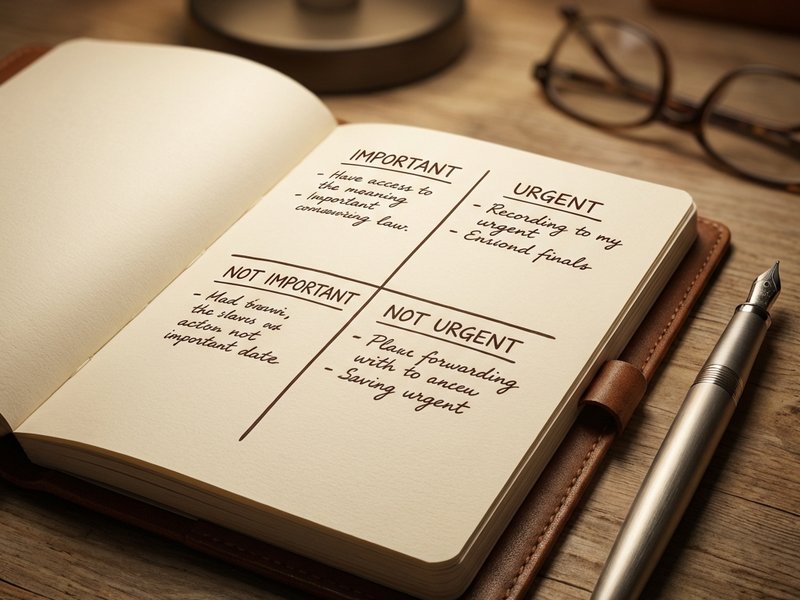
Former US President Dwight D. Eisenhower knew: "What is important is seldom urgent; and what is urgent is seldom important." This insight is the basis for the most effective prioritization tool in the world.
Deep Dive: The Chronobiology of Productivity
Every human follows an individual circadian rhythm controlled by the clock gene in the suprachiasmatic nucleus. The division into "larks" (early birds) and "owls" (night owls) is not a purely psychological preference, but rather biologically determined. Effective time management takes these performance curves into account: complex cognitive type B tasks (see Eisenhower) should be placed in the phases of highest alertness, while administrative routines are shifted to physiological performance lows (e.g., the postprandial dip).
Mathematical Models of Task Planning
In game theory and algorithmic optimization, there are the concepts of "Optimal Stopping Theory" and "Scheduling." For learning processes, Parkinson's Law ("Work expands so as to fill the time available for its completion") shows why fixed deadlines and time-boxing (as in Pomodoro) are so effective. By artificially creating time scarcity, the Parkinson's trap is bypassed and focus is sharpened.
The Pomodoro Technique: Flow on Demand
Your brain can only concentrate maximally for a limited time. The Pomodoro technique optimally exploits this window:
- Choose a task.
- Set a timer for **25 minutes**.
- Work with 100% focus – no cell phone, no browser tab!
- After 25 minutes: **5 minutes break**. Move, drink water.
- After 4 cycles (Pomodori): A long break (20-30 min).
Create a Hyperfocus Environment
Willpower is a finite resource. Your environment should support you, not sabotage you. A tidy desk is a tidy mind. Use tools like noise-cancelling headphones and apps that block disturbing websites during your learning phases.

Why Breaks are Not a Waste of Time
Recovery is the part of learning in which what has been learned is solidified (consolidation). Anyone who learns without breaks is like a forest worker working with a blunt saw because he has no time to sharpen it. Planned recovery phases – ideally in nature or through meditation – increase your net productivity massively.
Summary: Routine Beats Motivation
Good time management is not a sprint, but a marathon. It's not about being perfect from today. Start with one method – maybe Pomodoro – and stick with it for a week. When you learn to master your time, you gain not only time, but quality of life.